

The globally popular gaming IP "Pokémon" recently launched its latest mobile game, "Pokémon Sleep," which allows players to catch Pokémon while sleeping and check their sleep status, including light and deep sleep, upon waking. According to statistics, since its launch in late July, the app has surpassed 10 million downloads on both iOS and Android platforms. In addition to the buzz created by the popular IP, this also reflects modern people's curiosity about sleep data. However, how should this data be interpreted, and how should sleep quality be evaluated?
Understanding Sleep Stages: Deep Sleep Accounts for Less Than a Quarter of Total Sleep Time
In a recent video, Dr. Wu Qi-Ying, a YouTuber known as "Cang Lan Ge's Medical World," mentioned that sleep stages are divided into two types: "Non-Rapid Eye Movement" (NREM) and "Rapid Eye Movement" (REM). NREM is further divided into N1, N2, and N3.
Non-Rapid Eye Movement (NREM)
N1: This is the first stage of NREM, transitioning from wakefulness to sleep. During this stage, the heart rate, eye movement speed, brainwaves, and breathing gradually slow down, and muscles slowly relax into sleep, accounting for about 5% of total sleep time.
N2: This is the "light sleep stage," accounting for about 50% of total sleep. Core body temperature decreases, and eye movements stop. While it is harder to wake someone during this stage, sudden awakenings can still occur.
N3: This is the "deep sleep stage," the deepest stage of NREM, accounting for approximately 13% to 23% of total sleep duration. Muscles are completely relaxed, and heart rate, breathing, and brainwaves reach their lowest points. It is difficult to wake someone even with loud noises.
Rapid Eye Movement (REM)
The REM stage accounts for about 25% of total sleep time. As the name suggests, the eyes move rapidly from side to side, and brainwaves return to a state similar to wakefulness. This is the stage where dreams commonly occur. Cang Lan Ge stated that to prevent dangerous flailing of limbs during dreams, the body forces the muscles below the neck (voluntary muscles) into a semi-paralyzed state.
Anxiety Also Affects Sleep; "Heart Rate Variability" Becomes a Criterion for Assessment
To determine good sleep quality, Cang Lan Ge mentioned that in addition to the total sleep duration, sleep cycles must also be considered. For the average adult, he recommends at least seven hours of sleep, with deep sleep (N3) lasting for at least 1 to 2 hours, which is more beneficial for mental and physical restoration.
Factors such as drinking alcohol before bed, sleep apnea, daytime activities, and anxiety levels are also key to affecting sleep quality. Cang Lan Ge stated that HRV (Heart Rate Variability) during sleep can also be used as an assessment criterion. Higher HRV indicates a slower heart rate, longer intervals between heartbeats, and greater relaxation during sleep; conversely, low HRV may indicate bodily anxiety and difficulty relaxing.
Therefore, to effectively increase deep sleep time and sleep quality, Cang Lan Ge also summarized five recommendations in the video:
1. Go to bed and wake up at a fixed time to help the body adapt to a regular sleep cycle.
2. Maintain a healthy body weight and good exercise habits to prevent symptoms of sleep apnea.
3. Practice pre-sleep meditation and diaphragmatic breathing exercises to activate the parasympathetic nervous system.
4. Avoid strenuous exercise and using 3C products before bed.
5. Avoid caffeine intake after noon.
How to Catch Up on Sleep Correctly? Be Careful Not to Disrupt Your Sleep Cycle and End Up More Tired!
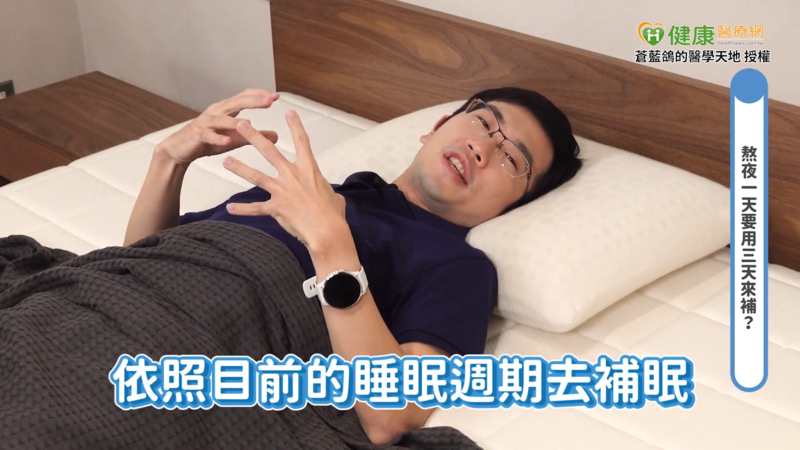
▲Dr. Wu Qi-Ying (Cang Lan Ge) advises that when catching up on sleep after staying up late, it is crucial "not to exceed two hours" to avoid disrupting the sleep cycle.
Many people stay up late on holidays watching dramas, singing karaoke, and playing video games, leading to a painful Monday at work or school. Is the common saying "one night of staying up requires three days to recover" actually true? Cang Lan Ge also answered this in his video. He reminded viewers that while it typically takes two to three days for the body to recover after staying up late, it is crucial "not to exceed two hours" when catching up on sleep, to avoid disrupting the sleep cycle and making it harder to fall asleep at night.
https://www.healthnews.com.tw/article/59137